
Engineering stories, methods, and ideas.
Practical work from simulation, physical testing, data, automation, and the decisions that connect them.
Latest articles
Strains and Stress in NonLinear Finite Element Method
Came across this nice document that talks about the strains and stress computations used in many nonlinear finite element codes. If you know the author of …
Automatic Tiebreak – Some Quick Notes
I posted a detailed document on the TIEBREAK contacts. Here are a few things that I noticed after the I wrote the article. 1. Scale down the penalty …
More on LSCASEDRIVER
In an earlier post, we saw how *CASE keywords can help us perform sequential and sequential+dependent simulations. But here I want to talk a little more …
Sense-Switch Controls for Interacting with Running LS-DYNA Jobs
There are several sense switch controls that are available to interactively request LS-DYNA respond to certain pre-defined calls. The well documented …
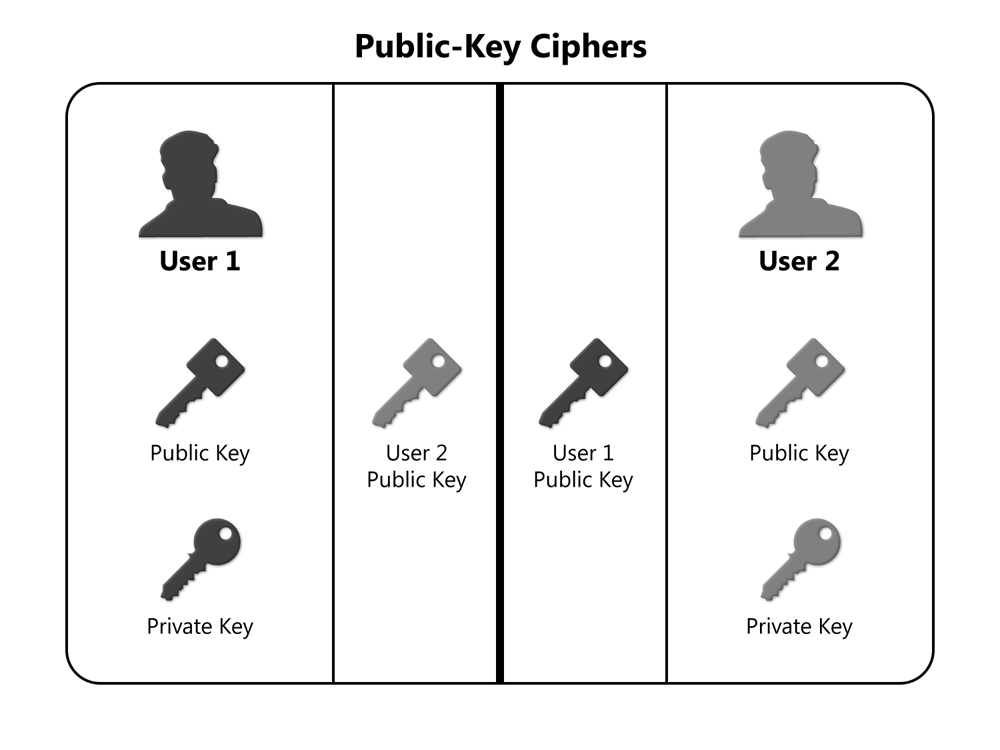
Encryption Comes to LS-DYNA v971 !
Encryption has been around for several years but it finally comes to LS-DYNA in the form of GPG encryption which can be used at no additional cost to …
Interactively Terminating LS-DYNA Jobs
There are several methods available to interactively termination an running LS-DYNA job. They are briefly discussed here. 1. Sense Switch ‘SW1’ This …
Features Every LS-DYNA Simulation Must Have
LS-DYNA is a general-purpose simulation software. This is a good thing for analysts since it provides tremendous flexibility in simulating a wide range of …
Energy Output to D3PLOT Files
Several options exist in LS-DYNA to output the energies, stress and strain information for shells, solids and beams depending on the choice of parameters …
Determining Prony Series Constants for Modeling Creep and Relaxation
Came across this excellent tutorial that talks in detail the steps involved in determining the Prony series constants. Determining a Prony Series for a …
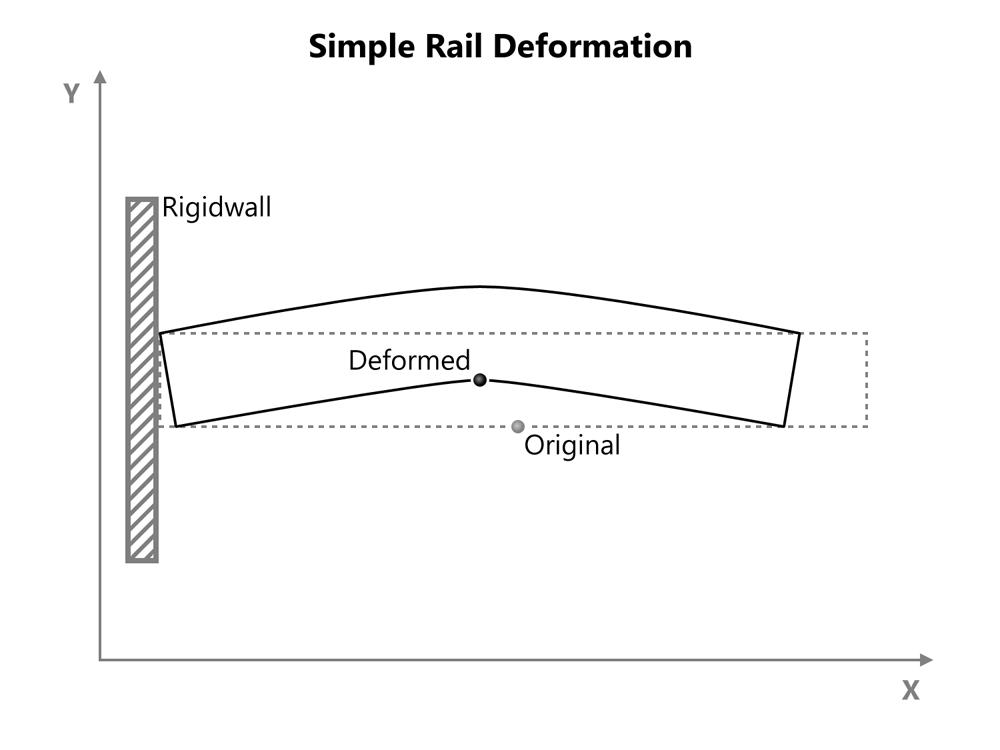
Nodal Time History in Local Coordinate System
In several simulations, the response of a nodal point (displacement, velocity, and acceleration) is helpful to be output in a user-defined local coordinate …
Accelerometer Mass
Starting 971, LS-DYNA allows the direct input of the physical accelerometer mass in the *ELEMENT_SEATBELT_ACCELEROMETER keyword which is lumped equally to …
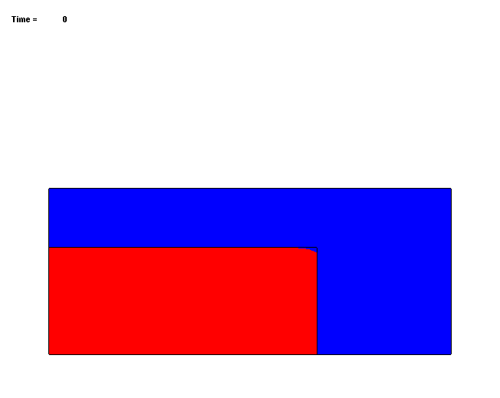
A Simple ALE Sloshing Example
Sloshing problems can be simulated using several techniques in LS-DYNA that range from using a simple MAT_ELASTIC_FLUID modeling to a complex ALE or SPH …