











Accurately calibrating failure behavior in polymer materials often requires more than identifying how far simulations deviate from physical test results. Once failure strain error has been quantified, engineers must determine how to translate that information into controlled updates of material regularization behavior. d3VIEW addresses this need with the *GISSMO_SCALE_REGULARIZATION_SCALE_FACTORS worker, which enables automated, rule-based scaling of GISSMO regularization curves driven directly by measured percentage error.
This worker is designed to be used in extension to the *DATASET_COMPUTE_FAILURE_STRAIN_ERROR worker as part of an iterative calibration loop. After simulations are run using a candidate polymer material card, failure strain is compared against reference test data and the resulting percentage error is computed. That error dataset can then be passed directly into the *GISSMO_SCALE_REGULARIZATION_SCALE_FACTORS worker, allowing regularization curves in the MAT_ADD_DAMAGE material card to be scaled automatically. The updated material data is subsequently used in the subsequent simulation iterations, enabling error-driven regularization updates without manual curve editing.
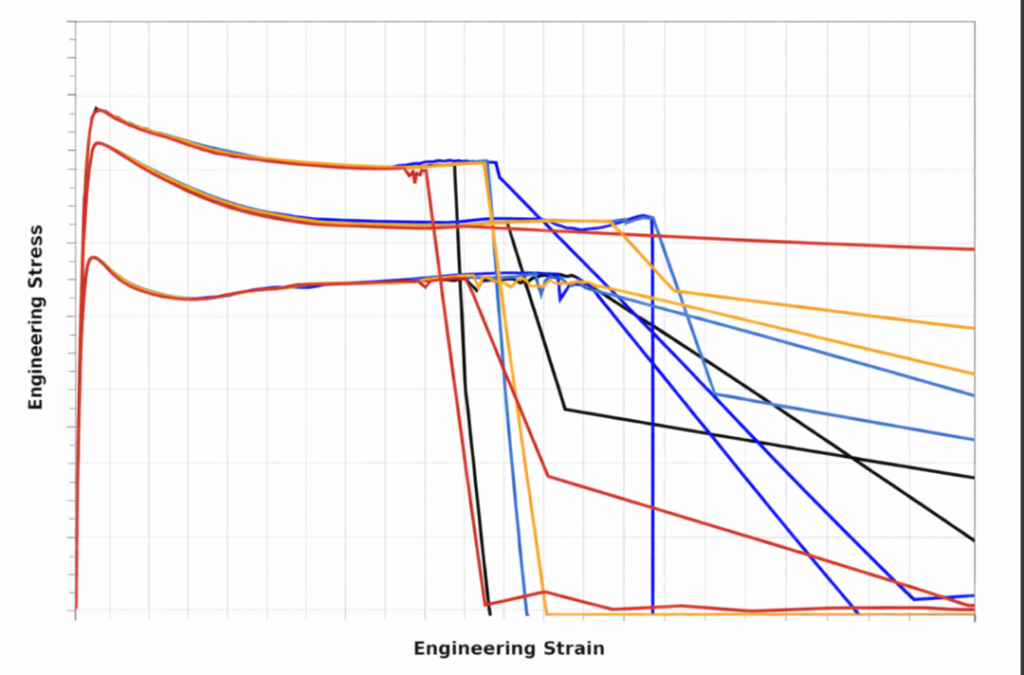
Figure 1: Comparison of reference test curve against multiple simulation iterations, illustrating mismatch in failure behavior and the motivation for regularization scaling. Curve in Black is the regularization target, and the colored curves are for different mesh lengths
By chaining these workers together, d3VIEW enables a closed-loop calibration process in which error measurement directly drives material regularization updates. This approach reduces subjective decision-making and replaces manual tuning steps with a structured, repeatable workflow.
The *GISSMO_SCALE_REGULARIZATION_SCALE_FACTORS worker consumes a percentage error dataset; typically generated from failure strain comparison and a GISSMO-based material card. Based on this information, it applies controlled scaling to the rate-dependent LCREG regularization curves and produces updated scale ratios, scaled curves, and a revised material card ready for subsequent simulation runs. Rather than requiring engineers to manually edit regularization curves between iterations, the worker applies consistent scaling logic governed by user-defined rules and thresholds.
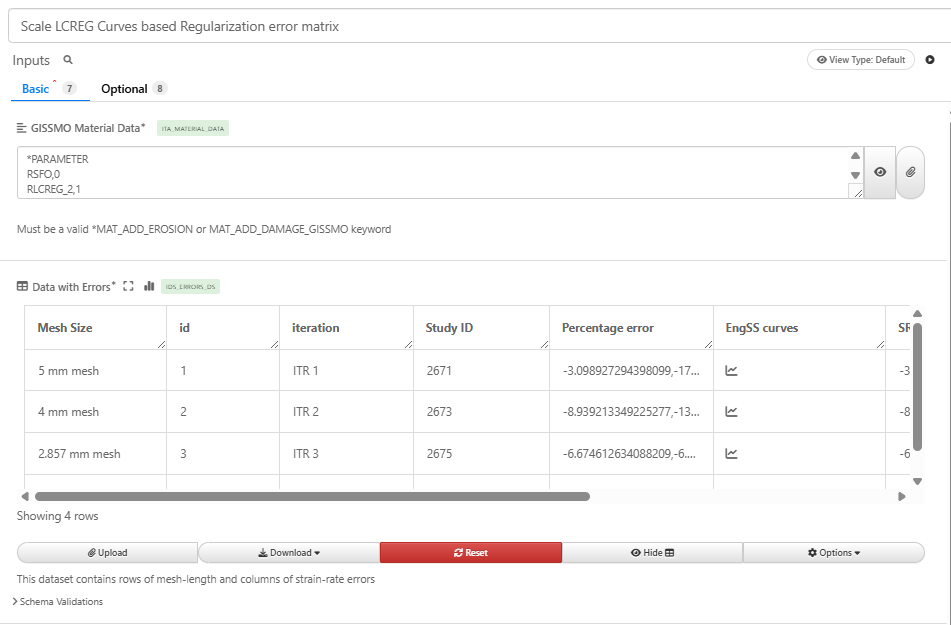
Figure 2: Percentage Error Dataset to scale LCREG curves
Beyond automating curve scaling, the worker provides several controls that help ensure regularization updates remain both effective and stable across iterations.
A key aspect of this worker is its threshold-based control over when scaling is applied. Scaling is triggered only when the percentage error falls outside a user-specified acceptable range, ensuring that material behavior is not modified unnecessarily. This allows simulations that already meet calibration targets to remain unchanged, while focusing adjustments only where improvement is required.
The worker supports two distinct threshold-based scaling approaches, providing flexibility in how aggressively regularization curves respond to error. In one mode, scaling is based on the total percentage error whenever the error exceeds the defined threshold range. This approach is typically used when the mismatch between test and simulation is significant and stronger corrections are desired, such as in early calibration iterations. In the second mode, scaling is based only on the portion of the error that violates the threshold range. This violation-only approach is particularly useful for fine-tuning, as it avoids over-correction when simulations are already close to the target response.
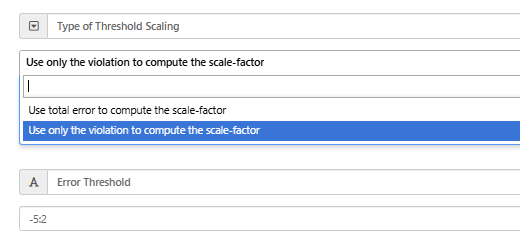
Figure 3: Worker input panel showing error thresholds and threshold scaling type selection (total error vs violation-only scaling)
The worker also supports restricting scaling to specific mesh sizes. This capability is particularly important in polymer workflows, where material regularization must often be validated across multiple mesh resolutions. By applying scaling only to selected mesh sizes, engineers can preserve calibrated behavior while iteratively regularizing material response where discrepancies remain.
Within d3VIEW’s polymer workflows, this worker is commonly used to iteratively regularize material cards across different mesh configurations. Engineers can evaluate failure strain error for each mesh, apply controlled scaling only where thresholds are violated, and track convergence independently for each discretization.
The effect of scaling is reflected in the worker’s outputs, which include LCREG scale ratios and scale factor tables that clearly show how error values translate into regularization updates.
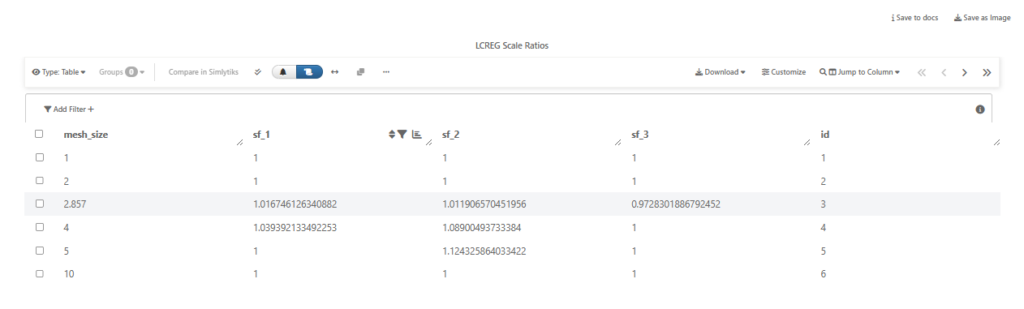
Figure 4: LCREG scale ratios or scale factors table showing computed scaling values derived from percentage error
Once scaling is applied, the worker produces an updated *MAT_ADD_DAMAGE material card with modified rate-dependent LCREG curves. This updated material data can be reused directly for subsequent simulation runs, closing the loop between error evaluation and material update.
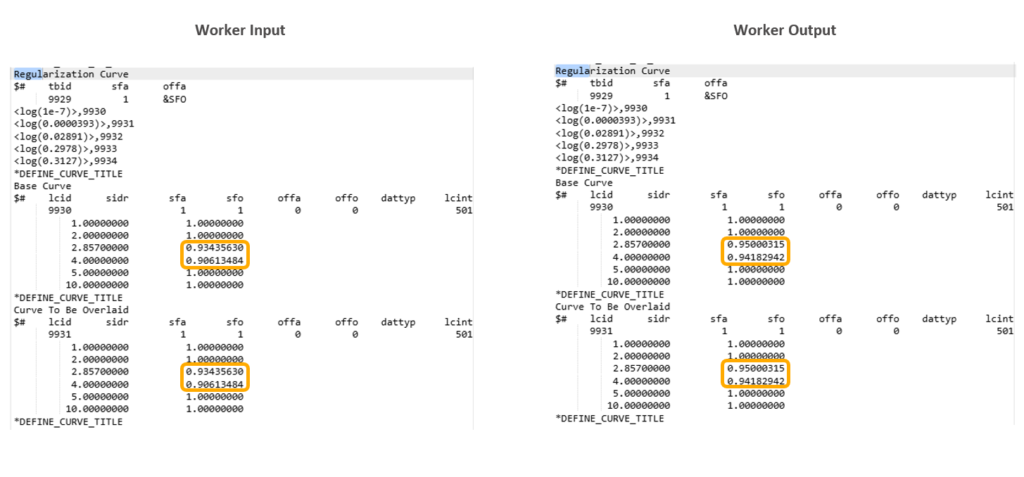
Figure 5: Updated *MAT_ADD_DAMAGE material data highlighting scaled LCREG curves
In summary, the *GISSMO_SCALE_REGULARIZATION_SCALE_FACTORS worker provides a natural next step after failure strain error evaluation. By directly consuming the output of *DATASET_COMPUTE_FAILURE_STRAIN_ERROR worker, it enables a controlled, mesh-aware, and repeatable approach to regularizing GISSMO-based polymer material models in d3VIEW.