








One of the core activities in virtual-product-development is compilation of a system-model, from assemblies, that can be evaluated across a wide range of load-cases. The traditional approach involves storing the assemblies in the form of files (solver inputs) on a storage device and then referencing them in a solver-main-input using includes (*INCLUDE, *INCLUDE_PATH). The biggest challenge that remains to be solved is the lack of traceability and the absence of a comprehensive view of the relationship between the evaluated designs and their respective outcomes as design evolves under different load-cases and engineers.
d3VIEW’s new AI-powered web-based Model-Assembler application solves this challenge this by providing a unified environment to create and manage assemblies thereby facilitating compilation of system-models with full lineage and traceability. Design evolution and corresponding outcomes are automatically captured, enabling teams to collaborate with visibility into every iteration. With the underlying AI and ontology-powered intelligence, companies can query and explore designs and their outcomes using natural language – unlocking a broader, more intuitive understanding of their product designs.
The image below illustrates this streamlined flow of data and information where an Engineer can create assemblies to compile a system-model, pass them to a load-case workflow, that creates the necessary simulation(s) with matching result and report templates. These results then eventually build Machine-learning models to identify optimal designs, enabling a continuous, intelligent design-optimization cycle.

IIn the image below, different assemblies of a system model are managed and aggregated into a full-vehicle system model using an intuitive interface. Each assembly can consist of a single or multiple versioned file/s that can eventually be compiled into a single system model. Each file can be versioned with a fully organized naming convention such as “BIW.k”, “BIW_001.k” and tagged to locate them later. Each assembly file can be edited, parameterized, and compared to identify critical changes.

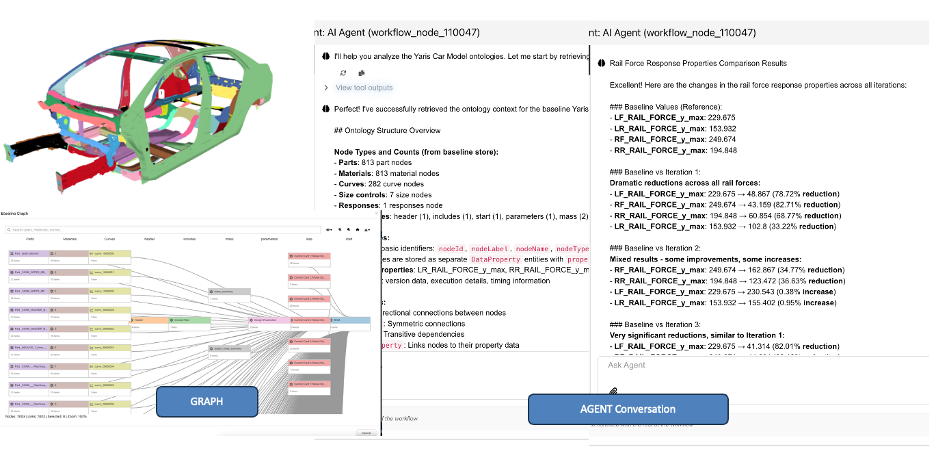
As more designs are created and analyzed, it can become extremely difficult to query and understand why a design is under-performing or meets the expected outcome. This is solved by using the knowledge graph of the data and by using Ontology concepts, we can now query the data and its relationships using simple natural language as shown below.
In a nut shell, d3VIEW’s AI-powered model assembler can help any organization to provide a central place to build and analyze systems providing full data and information traceability.