
Engineering stories, methods, and ideas.
Practical work from simulation, physical testing, data, automation, and the decisions that connect them.
Latest articles
Initially in Contact – TIEBREAK contacts
When using TIEBREAK contacts, options other than 1, ties nodes ONLY if the nodes are initially in contact. Nodes not initially in contact will not be tied …
New LS-OPT Support Site
A new LS-OPT support site is established with lots of useful information that covers examples, theory and many download materials.
Ten Recommendations to Improve Contact Stability for Explicit and Implicit Simulations
Here are 10 things (based on experience) that one can use to improve contact stability in any LS-DYNA simulations. They are not in any particular order. 1. …
SLURM: A Highly Scalable Resource Manager – Free and OpenSource
Clustered solutions dominate the market today with MPP-LSDYNA being used worldwide when 2 or more processors per job are used. Managing compute nodes …
Quaternions for 3D Graphics
A recent investigation to determine the best viewing configuration for any arbitrary model required me to understand the ‘QUAT’ that appears in LS-PREPOST …
LSDYNA Simulation Notes
While working on a simulation model, it is often very convenient for oneself or to others to make necessary notes that documents the changes in the input …
Internal Contact for Solids using *SET_SEGMENT_GENERAL
In an earlier post on CONTACT INTERIOR , we saw how adding interior contact can help prevent negative volumes. An additional method that is available in …
TIEBREAK Example
Here is a TAR file that consists of a simple setup to demonstrate TIEBREAK interface contact in LS-DYNA. The example can be used under TENSION, …
RCB Decomposition and LS-DYNA Built-In Intelligence
Domain decomposition is central to MPP-LSDYNA as it determines the final load balance on each of the compute nodes. The default (and most widely used) …
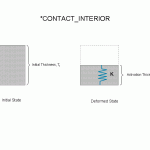
Interior Contact for Foams, Honeycombs and Rubbers to eliminate Negative Volumes.
Under large compressive forces, elements belonging to either Foams, Honeycombs and Rubbers tend to invert causing numerical instabilities. To avoid such …
Reduce D3PLOT File Size for RigidBodies
A simple variable ‘DCOMP’ can be used in *DATABASE_EXTENT_BINARY keyword to suppress unwanted information about rigidbodies to help reduce the size of …
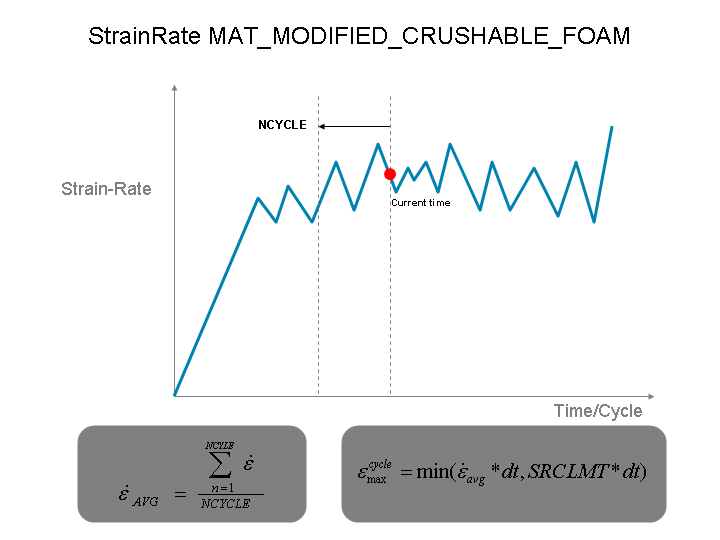
Modified Crushable Foam
LS-DYNA now offers a modified version of *MAT_CRUSHABLE_FOAM in the form of *MAT_MODIFIED_CRUSHABLE_FOAM . In the new material model, the strain rate …